
Monterey Bay Aquarium is one of the rare California attractions that can justify changing the structure of an entire Central Coast day. It sits directly on Cannery Row, has no public visitor parking lot of its own, and rewards slow observation more than fast exhibit collecting. A first visit is therefore less about finding the fastest route through the building and more about controlling the arrival, avoiding parking stress and choosing enough time that the kelp forest, open-ocean galleries and smaller exhibits do not become a race.
For most travelers, three to five hours is a realistic first visit. Families with young children or marine-life enthusiasts can easily stay longer. The Aquarium recommends buying tickets in advance through its official website, and 2026 tickets are sold for specific dates. Build the Monterey day around that commitment, then use Cannery Row and the coastal recreation trail as flexible time before or after.
Quick planning snapshot
| Decision | Practical answer |
|---|---|
| How much time? | 3–5 hours for most first visits; longer for families, photographers and marine-life enthusiasts. |
| Tickets | Buy in advance through the official Aquarium website for a smoother entry; avoid unofficial ticket sellers. |
| Parking | No public on-site parking. Use city garages, street options or public transport. |
| Best pairing | Cannery Row, Monterey Bay Coastal Recreation Trail and a relaxed waterfront meal—not an overpacked Big Sur driving day. |
How to choose your visit time
Morning entry is useful if you want a calmer start and plan to continue with Monterey sightseeing afterward. A later visit can work if you spend the morning outdoors, but do not arrive close to last entry and expect a complete experience. The Aquarium states that last entry is one hour before closing, yet that is not the same as saying one hour is enough.
Check the daily schedule for feedings, talks and programs. Choose one or two rather than trying to attend everything. Fixed programs can enrich the visit, but excessive schedule chasing creates the same problem as in a theme park: you spend more time moving than observing.
A practical half-day route
First hour: start with one iconic gallery
Choose the Kelp Forest, Open Sea or another major area as your first anchor rather than wandering randomly from the entrance. Spend enough time for the exhibit to change in front of you; large marine environments reward waiting.
Second block: smaller galleries and interpretation
After the headline exhibit, move through nearby galleries and read the conservation interpretation. Children often need a change in scale, so alternate large viewing windows with interactive or smaller spaces when possible.
Midpoint: program or food break
Use one scheduled program as the midpoint of the visit, or take a meal break before everyone becomes hungry. Because same-day re-entry is permitted with the Aquarium’s current handstamp process, some travelers prefer to step outside briefly and return. Confirm the current procedure on the day.
Final block: return to a favorite
A second look at a major gallery is often more rewarding than squeezing in every corner. Animal activity and crowd density change. Leave enough time to exit without immediately rushing into a long drive south on Highway 1.
Parking and transportation without frustration
The Aquarium does not provide public visitor parking on site. City garages and metered street parking serve Cannery Row and downtown Monterey. On busy weekends, the closest spaces fill early, so parking slightly farther away and walking the coastal trail can be less stressful than circling near the entrance.

Between Memorial Day and Labor Day, Monterey-Salinas Transit operates a free wheelchair-accessible trolley with a stop near the Aquarium according to the current Aquarium accessibility guidance. Seasonal operation can change, so verify dates. Public transit and bicycles are viable for travelers already based in Monterey.
Families, strollers and accessibility
The Aquarium is designed to be broadly accessible and provides elevators and accessible facilities. Strollers and wagons are permitted in most public areas, with some exceptions. On crowded days, a large stroller can be harder to maneuver through dark galleries, so use the designated stroller parking when it genuinely simplifies the experience and keep valuables with you.
For children, do not treat every exhibit as a lesson that must be completed. Let them spend longer at two or three animals that capture their attention. A child who watches sea otters for twenty minutes may learn more than one pushed through ten galleries in the same time.
What it costs and how to decide if it is worth it
The Aquarium is a premium-priced attraction. In 2026, adult admission is substantially more expensive than a small local museum, with reduced youth and senior rates and free admission for very young children. Check current pricing because it can change. Families should compare the cost with how much time they realistically want to spend inside rather than viewing it as a quick Cannery Row stop.
Membership can make sense for repeat regional visitors, while programs such as Museums for All expand access for eligible guests. Use the official eligibility details rather than third-party coupon sites. The Aquarium states that tickets are sold through its official site, which is also the safest place to avoid invalid products.
How to fit the Aquarium into Monterey, Carmel and Big Sur
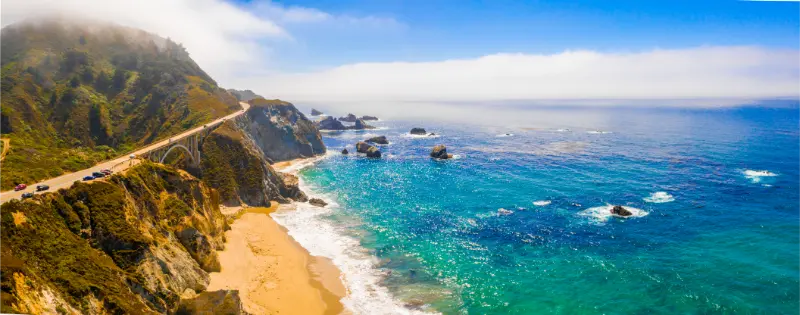
Do not pair a long Aquarium visit with an ambitious Big Sur driving schedule. Coastal road conditions, viewpoint stops and traffic make that combination fragile. A better first visit uses one Monterey half-day and keeps Big Sur or Point Lobos for a separate block.
Cannery Row itself is tourist-oriented, but the waterfront location makes it useful for a meal and a walk. The coastal recreation trail can provide a low-cost counterbalance to the ticketed Aquarium and is particularly pleasant when you want fresh air after several indoor hours.
Common mistakes to avoid
- Assuming the Aquarium has its own public parking lot.
- Buying from an unofficial ticket seller.
- Arriving one hour before closing and expecting a full visit.
- Scheduling a long Aquarium visit and a full Big Sur drive on the same day.
- Trying to attend every feeding or program.
- Rushing children away from the exhibits that genuinely hold their attention.
How to combine this with a wider California trip
Use the Aquarium as one anchor within Monterey, Carmel and Big Sur itinerary. Then give Point Lobos guide or Big Sur its own separate time window. If you are moving south afterward, San Luis Obispo guide is a natural later road-trip base rather than something to squeeze into the same afternoon.
Useful California for You guides
Read Monterey, Carmel and Big Sur itinerary, Point Lobos guide, San Luis Obispo guide and 10-day California road trip.
Official planning resources
Ticket availability, hours, programs, trolley operation and parking conditions should be checked close to the visit.
Final advice
The Aquarium is worth planning around because its best experiences are slow ones. Buy the correct ticket, solve parking before arrival and protect at least several hours.
Then resist the urge to compensate for the ticket price by rushing. The value comes from observing the living exhibits long enough to notice something you would have missed in a five-minute pass.
A better way to plan the day
For Monterey Bay Aquarium for First-Time Visitors, write down three levels of priorities before the trip: one experience that would make the day worthwhile, two experiences you strongly prefer, and several optional items. This prevents a delay or closure from turning into a chain of rushed decisions. California travel days often look easy on a map but contain hidden transition time—parking, walking from a garage, security, restroom stops, hotel check-in or slow mountain roads. A plan with deliberate slack usually produces more useful sightseeing time than a plan with every half hour assigned.

Save the official ticket or reservation, the exact first parking location, the attraction map and the next hotel address in one offline note. Do this before leaving the hotel. If cellular service is weak or the official app logs you out, you still know where to go. Families can add the meeting point and one phone number in case the group separates. This small preparation is more valuable than carrying a long list of recommendations you cannot find when everyone is tired.
What to book and what to leave flexible
Book only the elements that can genuinely sell out or control the rest of the day: admission tied to a date, limited tours, important restaurant reservations, ferries or special experiences. Leave ordinary meals, viewpoints, minor exhibits and shopping flexible whenever possible. Too many reservations turn a vacation into a series of deadlines and make normal delays feel like failures.
When accommodation is involved, compare total trip cost rather than the room rate alone. Parking, resort fees, breakfast, rideshares and the time spent commuting can make a cheaper hotel more expensive in practice. A well-located room can also create an extra useful hour in the morning, which is especially valuable at attractions where early arrival reduces queues or parking stress.
Comfort and safety checklist
- Check the official operating or conditions page the evening before travel and again in the morning when weather or closures are possible.
- Carry water and sun protection even when the destination includes indoor spaces.
- Keep a light layer in the car or day bag for coastal wind, air-conditioning or evening temperature changes.
- Do not leave visible luggage, cameras or electronics in a parked vehicle.
- Decide in advance which optional stop will be dropped first if the day runs late.
- Give children and older travelers a real seated break before they ask for one.
These details are not glamorous, but they are the difference between an itinerary that looks good on a screen and one that works for real people. The goal is not maximum attraction density. It is a day that still feels enjoyable when parking takes longer, a child wants to stay somewhere, an animal is not visible, a ride closes or the weather changes.