The best California beach for a family is not automatically the prettiest one. With babies, toddlers, grandparents or a wheelchair user, practical details can matter more than the postcard view: how far is the sand from parking, are there restrooms, is the surf powerful, can you walk to food, is there shade, and can the day work without carrying half the house down a cliff staircase?
This guide uses those questions to compare family-friendly beach choices across the state. It is not a ranking of the most dramatic coastline. Instead, it helps you choose a beach that matches the ages, swimming confidence, mobility and patience of the people actually traveling with you.
How I judge a family beach
| Factor | Why it matters |
|---|---|
| Parking and access | Shorter, flatter access matters when you carry strollers, coolers or mobility equipment. |
| Water conditions | Gentler-looking water is still ocean water. Lifeguards and daily conditions matter more than reputation. |
| Restrooms and food | A beautiful remote cove can become difficult with small children if basic facilities are far away. |
| Space beyond the sand | Boardwalks, playgrounds, piers and nearby towns help when part of the group is finished with the beach. |
| Accessibility | Beach wheelchairs, mats and paved promenades can transform a trip for travelers with limited mobility. |
1. Santa Monica: easiest for a first urban beach day
Santa Monica is not the quietest California beach, but it is easy to understand. The pier, broad sand, paved path and nearby restaurants give families multiple ways to reset. If a child gets tired of the ocean, you do not have to end the whole day. Public transport and nearby hotels also make it one of the few beach destinations where you can avoid driving for part of the visit.
The trade-off is crowds and urban intensity. Arrive early, set a clear meeting point and keep younger children close near the water and pier. Santa Monica works especially well when the beach is one part of a Los Angeles trip rather than the only reason for the vacation.
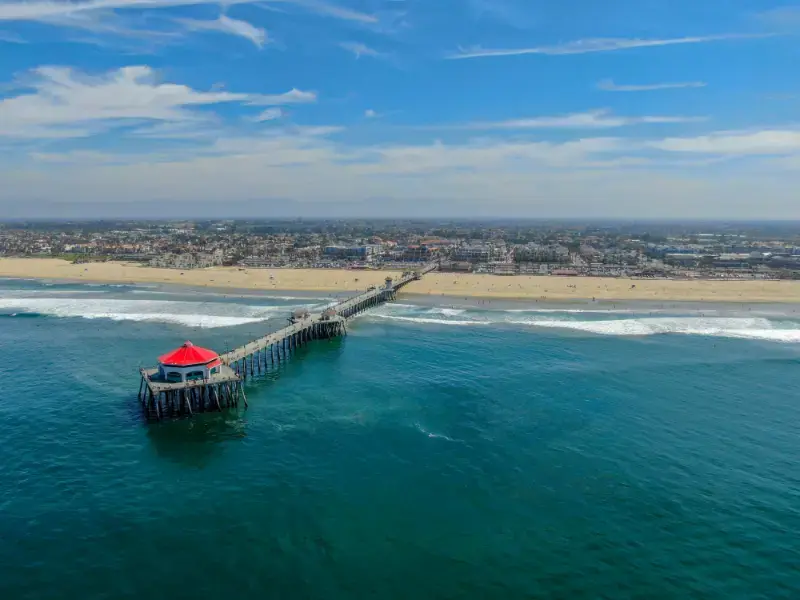
2. Huntington Beach and Bolsa Chica: space, a long paved path and classic surf culture
Huntington gives families a broad, active beach environment with a pier and a long multi-use path. Just north, Bolsa Chica State Beach adds large day-use areas, fire rings and a paved trail that connects toward Huntington State Beach. California State Parks lists a beach wheelchair at Bolsa Chica, which can be important for multi-generational groups.
This is surf country, so do not translate a broad sandy beach into gentle water. Stay in lifeguarded zones and follow daily warnings. The paved path is a major advantage for grandparents, bikes, scooters and anyone who needs a break from sand.
3. Corona del Mar and Newport Beach: choose harbor calm or ocean energy
Newport gives you several family choices within one destination. The open-ocean beaches offer classic sand and surf, while Balboa Island and harbor areas provide calmer walking, ferries and waterfront time that can rescue a windy or high-surf day. Corona del Mar can feel more compact and scenic, but parking demand increases on good-weather weekends.

The strength is flexibility. A family does not have to commit to eight hours on one beach. You can combine a morning in the sand with the ferry, harbor walk or early dinner.
4. Doheny State Beach, Dana Point: strong for mixed-age groups
Doheny State Beach is one of the Southern California options I like for mixed-age families because developed facilities sit close to the beach and harbor. California State Parks describes an accessible paved Beach Promenade Trail and beach wheelchairs. That does not guarantee every part of the shoreline is accessible, but it gives the day more options.
Dana Point Harbor nearby adds food, boat activity and whale-watching possibilities. For a grandparent-and-grandchildren trip, that variety can be more useful than choosing an isolated cove with better photographs.
5. Laguna Beach: beautiful, but choose the exact beach carefully
Laguna Beach is a collection of coves and beaches rather than one uniform family beach. Some involve stairs, limited parking or stronger shore break. Main Beach is the simplest introduction because it sits beside downtown services, while other coves can be saved for families comfortable with steeper access.
Treat Laguna as a town-and-beach day. Use the trolley when it fits the season and route, walk downtown, and avoid moving the car every hour. With toddlers or mobility limitations, research the exact beach entrance before leaving the hotel.
6. La Jolla Shores, San Diego: a strong all-rounder
La Jolla Shores is a classic family choice because the beach is broad, the adjacent neighborhood has food and the setting works for both sand time and coastal exploration. Conditions vary, and the Pacific is never a swimming pool, but the overall day is easier than at many cliff-backed coves.
Combine the beach with a short neighborhood walk rather than trying to visit every La Jolla viewpoint in the same afternoon. Parking can become the main challenge on busy days, so early arrival is more useful than an elaborate schedule.
7. Coronado: wide beach and an easy town combination
Coronado works well when adults want an attractive town and children want a straightforward beach. The sand is wide, the community is walkable in parts and you can add cafés or a bay-side walk without driving across San Diego repeatedly.

Summer weekends are busy, and shade is limited on the open beach. Bring sun protection and do not assume the famous hotel area means every facility is public or included. The family advantage is the ability to shift between beach and town with minimal drama.
8. Carpinteria: a gentler Central Coast rhythm
Carpinteria State Beach is a useful stop for families driving the Central Coast because the beach, town and campground environment sit close together. It is less about major attractions and more about an easy day where food, restrooms and a walkable small town reduce logistical friction.
For a road trip, that simplicity matters. Children get beach time without adults sacrificing an entire transfer day, and older travelers can enjoy the coastline without a long cliff trail.
9. Pismo Beach: beach plus pier plus road-trip convenience
Pismo Beach is one of the easiest Central Coast stops to understand with children. The pier and downtown sit close to the sand, lodging is plentiful and Highway 101 access is straightforward. It works well as a two-night break between Los Angeles and San Francisco.
The ocean can be cold and surf conditions vary, so the family plan should not depend on swimming. Sand play, the pier, coastal walks and nearby food can fill the day even when the water is too rough or cold.
10. Santa Cruz: best when children want more than the beach
Santa Cruz combines beach time with the Boardwalk, West Cliff, surfing culture and redwood day trips. That makes it especially strong with school-age children and teenagers who may not want to sit on sand all day. The trade-off is stimulation: weekends can be crowded and expensive if rides, food and parking are added spontaneously.

Decide in advance whether the day is mainly beach or mainly Boardwalk. Trying to maximize both can become tiring for young children. A two- or three-night stay makes the combination much easier.
Beach accessibility: check equipment, not just the word accessible
The California Coastal Commission maintains information on beaches that lend beach wheelchairs, many free of charge. California State Parks also publishes accessibility pages for individual parks. Availability, reservation procedures and staffing change, so call or check the official page before the trip rather than arriving with an assumption.
A beach wheelchair is only one part of access. Look at disabled parking, the route to the sand, restroom accessibility, boardwalks, shade and whether someone must push the chair. For some travelers, a paved oceanfront path may provide a better experience than reaching the waterline itself.
Ocean safety with children
Choose lifeguarded beaches whenever possible and read the daily flags or posted warnings. Rip currents, shore break, cold water and changing tides can affect beaches that looked calm in yesterday’s photos. Keep small children within arm’s reach near the water and never assign supervision to someone who is distracted by a phone or conversation.
Do not inflate the day with water toys that create extra risk in wind or surf. The simplest family beach kit—shade, water, towels, dry clothes, sun protection and a small first-aid kit—is often the best.
Best beach choices by family type
| Group | Good starting point |
|---|---|
| Baby or toddler | Santa Monica, Doheny, Carpinteria or Pismo for nearby facilities and easy resets. |
| School-age children | Huntington/Bolsa Chica, Santa Cruz or Coronado for space and extra activities. |
| Teenagers | Huntington, Santa Cruz, La Jolla Shores or Newport for surf culture and more independence within a defined area. |
| Grandparents + children | Doheny, Santa Monica, Coronado or Pismo where non-sand activities are close. |
| Mobility limitations | Start with official beach-wheelchair and access listings, then choose the exact facility rather than the town name alone. |
What to pack without overpacking
Bring a shade solution that is legal and practical for the beach, refillable water, sunscreen, hats, a dry clothing layer and simple snacks. Coastal California can be chilly even when inland temperatures are high. A light jacket for children and older adults is useful on many summer mornings and evenings.
For babies, add more fresh water than you expect to need and a way to create shade. For grandparents, a real chair with back support can be more valuable than another cooler. For everyone, use a waterproof pouch for keys and medication rather than depending on a pile of towels to hide valuables.
Parking strategy matters more than most families expect
At popular beaches, the difference between arriving at 8:30 and 11:30 can be an hour of parking frustration. Either arrive early or choose a hotel where you can walk to the beach. If you plan to leave for lunch and return, confirm whether re-entry is practical; some lots fill again immediately.
Never make children wait in a hot parked car while adults debate parking options. If the lot is full, move to the backup beach or town plan you chose in advance.
Useful California for You guides
For detailed destination planning, use our Santa Monica guide, our Huntington Beach guide, our Newport Beach guide, our Dana Point guide, our Laguna Beach guide, our Pismo Beach guide, our Santa Cruz guide and our California with Kids guide.
Official accessibility and beach information
- California Coastal Commission beach wheelchair map and list
- California State Parks accessibility resources
Common family beach mistakes
- Choosing a remote cove because it photographs well without checking stairs, restrooms or parking.
- Assuming a famous surf beach is appropriate for inexperienced swimmers.
- Arriving at peak time with no backup parking plan.
- Keeping children in wet clothes until evening and discovering the coast is much colder than expected.
- Treating grandparents or wheelchair users as spectators instead of planning access around their experience too.
Final advice
The best California family beach is the one that lets everyone have a good day, not the one with the highest social-media ranking. Match the beach to your children’s ages, the ocean conditions, parking tolerance and mobility needs. When the logistics are easy, the family has far more attention left for the part that matters: actually enjoying the Pacific together.