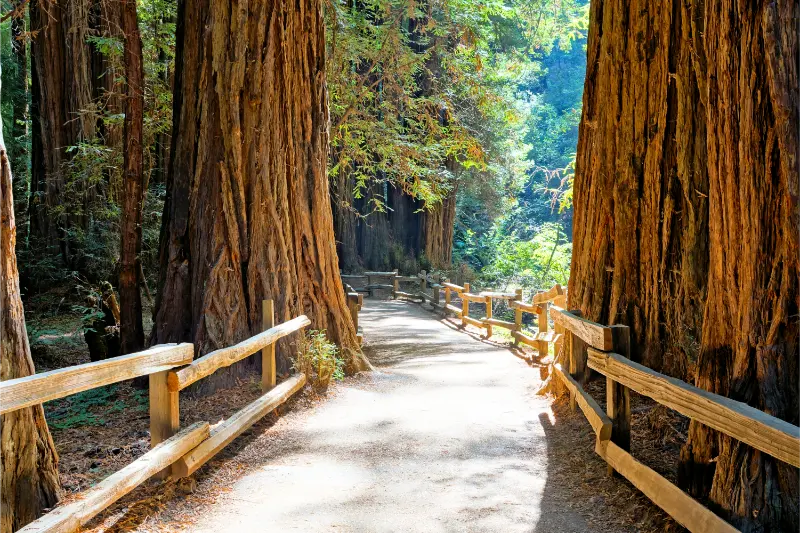
Muir Woods is close enough to San Francisco to look like an easy spontaneous side trip, but the visit works best when you treat the logistics as part of the attraction. The redwood grove is compact, parking is controlled, shuttle seats are limited by schedule and season, and cell service can be unreliable in the canyon. A good visit therefore begins before you leave the city: secure the required parking or shuttle reservation, choose a realistic arrival window, and decide whether you want a short accessible redwood walk or a longer hike into the surrounding hills.
The reward is that you do not need a full wilderness expedition to stand beneath old-growth coast redwoods. The main canyon trail lets first-time visitors experience the scale, quiet and filtered light of the forest without committing to a difficult hike. That makes Muir Woods unusually useful for multigenerational trips: grandparents, young children and stronger hikers can share the first part of the visit and then split into different routes without wasting the day.
Quick planning snapshot
| Decision | Practical answer |
|---|---|
| Reservation | A parking or shuttle reservation is required for vehicles and shuttle riders; this is separate from the park entrance pass. |
| Time needed | About 2–3 hours for the main grove; half a day if you add a longer trail or Sausalito. |
| Best strategy | Book an earlier arrival, walk the main grove first, and add mileage only if the group still has energy. |
| Biggest mistake | Driving toward the monument without a confirmed parking/shuttle plan and assuming you can improvise at the entrance. |
Why Muir Woods deserves a separate plan from San Francisco
Muir Woods is geographically close to San Francisco but operationally different from a city attraction. You are entering a narrow forested canyon with controlled vehicle access, limited parking and weather that can feel cooler and damper than the city. The right mental model is a small national-park outing, not a museum you can drop into whenever traffic allows.

That distinction is important because the redwoods themselves are best experienced slowly. If you arrive stressed from parking uncertainty and immediately rush toward the farthest bridge, you miss the atmosphere that makes the grove special. I would rather spend ninety calm minutes on the main route than four hours trying to combine every trail, viewpoint and nearby town into a single overpacked morning.
A realistic half-day Muir Woods plan
Step 1: arrive with the transport plan already solved
Leave San Francisco with extra margin for bridge traffic and winding roads. If using the shuttle, treat the shuttle time as a fixed appointment rather than a rough suggestion. If driving, save the reservation details offline before entering the canyon. There is no advantage in arriving dramatically early if your parking slot does not allow it, so use the reservation system to shape the day rather than fighting it.
At the entrance, use restrooms and orient the group before starting. Families should decide who carries water and layers; older travelers should note benches and the route back. The canyon can be cool even when San Francisco or Marin is sunny, so a light layer is often more useful than people expect.
Step 2: walk the main grove before choosing any extension
The Main Trail is the core experience. Move slowly through Cathedral Grove and the areas around the numbered bridges instead of treating the trail as a race. The boardwalk and compacted surfaces make the lower canyon relatively approachable, but conditions can change, so check current trail notices before assuming every side route is open.
Once everyone has experienced the redwoods, decide whether to turn back or climb. This is the moment to separate enthusiasm from obligation. Strong walkers may enjoy a loop using hillside routes when open; visitors with limited mobility often get more from a comfortable return through the grove than from pushing into steeper terrain.
Step 3: add Sausalito only if the timing still feels easy
Sausalito pairs naturally with Muir Woods, but it should be the optional second half of the day rather than the reason you rush the forest. Lunch and a waterfront walk can work well after the grove, especially for families who want a less structured afternoon. If the woods take longer than expected, skip Sausalito without regret; it is easier to revisit than a timed Muir Woods reservation.
Where to stay and why location matters
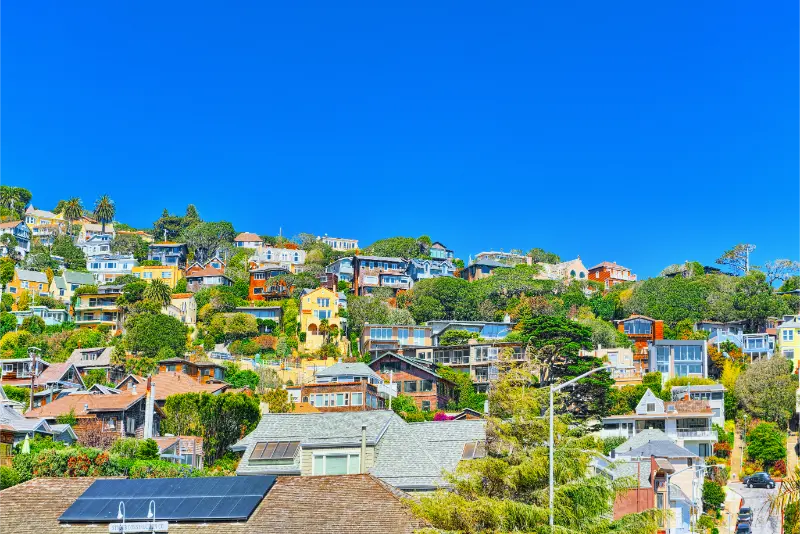
For most first-time visitors I would stay in San Francisco and treat Muir Woods as a half-day excursion. This keeps the trip simple and gives you a larger choice of hotels, restaurants and public transportation for the rest of the city stay.
Staying in Marin makes sense when Muir Woods is part of a North Bay itinerary with Point Reyes, Mount Tamalpais or Sonoma. In that case, the value is not proximity to the entrance alone but avoiding repeated Golden Gate Bridge crossings. Choose the base based on the next two days, not just this one morning.
Getting there and getting around
Driving gives flexibility but does not eliminate the reservation requirement. Parking spaces are tied to the reservation system, and there is no productive strategy of circling nearby roads looking for an unofficial alternative. The canyon roads are narrow and winding; motion-sensitive passengers may prefer a slower pace and a front seat.
The seasonal shuttle can be a smart choice for visitors who do not want to drive the final canyon approach, but shuttle operations vary. Confirm the pickup location, schedule and return procedure on the official reservation site close to the visit. Do not rely on an old blog post for current shuttle details.
Best time to visit
Muir Woods is a year-round destination, but the experience changes with rain, fog, school holidays and daylight. Winter can feel especially atmospheric and green, while summer brings the largest visitor pressure. Earlier time slots generally make it easier to hear the forest rather than a constant stream of conversations.
Rain should not automatically cancel the visit; redwoods and wet weather belong together. What matters is clothing, slippery surfaces and current trail conditions. Heat elsewhere in the Bay Area also does not guarantee heat in the canyon, so dress for microclimates.
Families: what changes when children are part of the trip
With children, make the forest itself the activity. A short scavenger-style walk—looking for ferns, bark textures, fallen logs and filtered light—usually works better than promising a long hike. Strollers may be practical on portions of the main route, but families should check current accessibility and trail conditions. Build in a snack and restroom stop before leaving because the winding drive can feel longer when a child is tired.
Older travelers and limited mobility
Muir Woods is one of the better redwood experiences for travelers who need a relatively gentle introduction, but ‘accessible’ does not mean every trail is level. The main lower-canyon route offers the easiest experience, while many hillside trails are steeper and may include uneven surfaces. Visitors using wheelchairs or with limited stamina should review the NPS accessibility information and current trail notices, then plan the return point in advance rather than deciding only after fatigue sets in.
Budget and time: where visitors usually miscalculate
The cost is not only the entrance fee. Parking or shuttle reservations are separate, and a rental car may add bridge tolls and parking costs elsewhere in the Bay Area. The bigger budgeting mistake, however, is time: a two-hour forest visit can consume half a day once city traffic, the bridge, winding roads and shuttle timing are included. Protect that time instead of squeezing Muir Woods between two fixed city reservations.
Mistakes I would avoid
- Arriving without the required parking or shuttle reservation.
- Assuming mobile service will be strong enough to retrieve every confirmation at the last minute.
- Starting with a steep trail before older travelers or children have enjoyed the main grove.
- Planning a rigid lunch reservation in San Francisco immediately after the visit.
- Treating Sausalito, Muir Woods and Point Reyes as one casual half-day loop.
The common pattern behind these mistakes is underestimating logistics. Muir Woods is easy physically for many visitors, but the access system rewards people who make a few decisions early. Once those decisions are solved, the actual forest visit can be wonderfully simple.
How to combine this stop with a longer California trip
For a one-week Bay Area trip, pair Muir Woods with San Francisco and one North Bay day. Point Reyes works better as a separate full day than as a quick add-on. If you are continuing toward Sonoma or Napa, Muir Woods can become the transition morning between the city and Wine Country, saving you from backtracking across the Golden Gate Bridge.
Useful California for You guides
For the wider route, I would also use our San Francisco guide, our Point Reyes guide, our Sonoma guide.
Official information to check before you go
Reservation rules, shuttle operations and trail conditions can change, so verify them on the official pages shortly before the visit.
Questions first-time visitors usually ask
Do I really need a reservation if I only want to walk for an hour?
Yes for parking or shuttle access. The reservation system is about transportation capacity, not how long you remain in the grove.
Can I visit Muir Woods and Point Reyes on the same day?
Technically yes, but I would not recommend it for most first-time visitors. Point Reyes is geographically spread out and deserves its own weather and driving margin.
Is Muir Woods worth it if I will visit the far Northern California redwoods?
Yes if time allows, but the experiences are different. Muir Woods is compact and convenient from San Francisco; the Redwood National and State Parks region offers a much larger wilderness landscape.
Final advice
Book the access first, then simplify everything else. Walk the redwoods before thinking about the next stop, let slower travelers set the initial pace, and keep the second half of the day flexible. Muir Woods is at its best when it feels like a quiet forest visit rather than a reservation you are trying to beat.