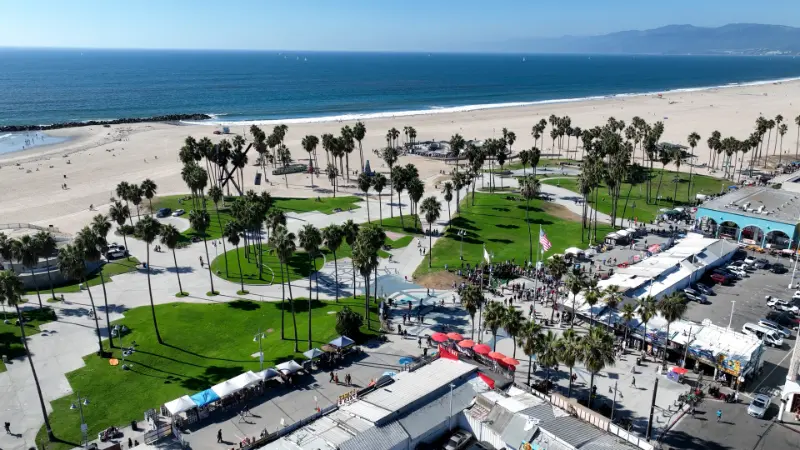
Venice Beach is not a polished resort beach. It is a dense mix of ocean, boardwalk performers, skate culture, fitness history, souvenir commerce, street art, local residents and visitors. That intensity is exactly why some travelers love it and others leave after an hour. A first visit goes better when you know which version of Venice you want to experience.
The most balanced plan combines a deliberate boardwalk walk with the beach, canals or Abbot Kinney rather than spending the entire visit in the busiest commercial strip. Two to five hours is usually enough unless you are genuinely having a beach day.
Quick planning snapshot
| Decision | Practical answer |
|---|---|
| How much time? | 3–5 hours for boardwalk, beach and Abbot Kinney; longer for a full beach day. |
| Best for | People-watching, skate culture, ocean atmosphere, street life and travelers who like neighborhoods with personality. |
| Parking reality | Private and public lots vary widely in price; read signs carefully and never leave valuables visible. |
| Good pairing | Santa Monica is close enough to combine by bike, walk or short ride, but each area has a different atmosphere. |
What Venice does better than a generic beach stop
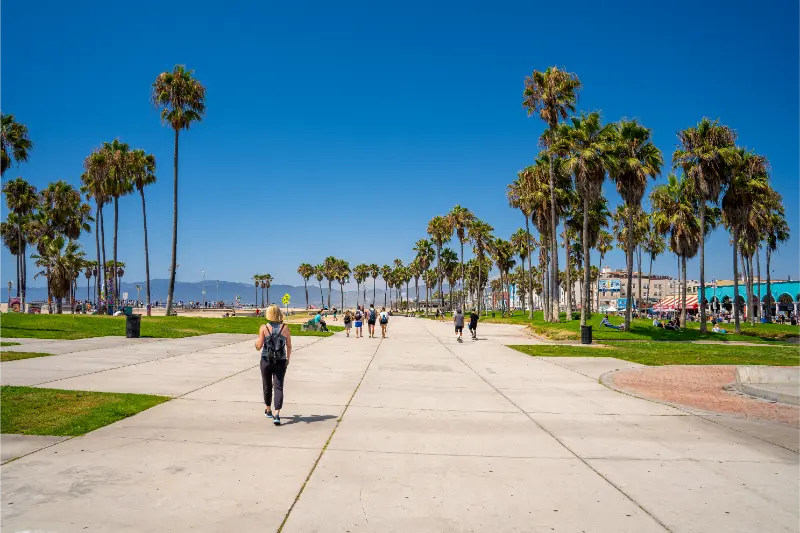
Venice is memorable because the beach is only the background. Muscle Beach, the skatepark, basketball courts, murals and boardwalk create a public stage that changes hour by hour. If you arrive expecting quiet sand and luxury shops, you may be disappointed; if you arrive for urban beach culture, the neighborhood makes more sense.
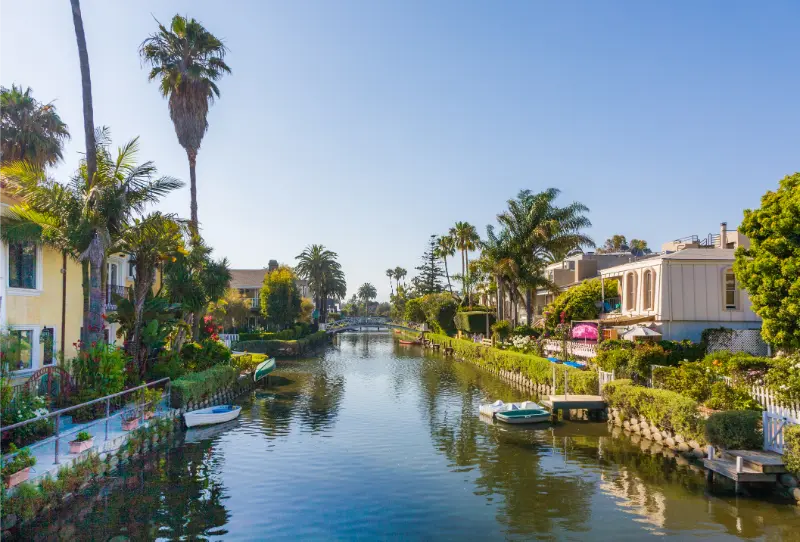
The canals and Abbot Kinney add important contrast. They reveal residential and design-focused sides of Venice that disappear if you remain on the boardwalk. A first-time itinerary should include at least one of these quieter zones.
A realistic first-visit route
Start near the beach before the boardwalk becomes overwhelming
Park once or arrive by transit/rideshare, then walk to the ocean first. Spend a few minutes understanding the geography: sand and bike path on one side, boardwalk businesses on the other. This orientation helps you avoid wandering without direction.
Walk the skatepark and classic Venice landmarks
The skatepark is one of the most distinctive public spaces in the area and is interesting even if you do not skate. Continue past the most recognizable boardwalk sections but do not feel obligated to inspect every shop. The atmosphere repeats after a while.
Choose canals or beach time as the middle block
For a calmer experience, walk toward the Venice Canals and respect that they are residential streets. If the weather is good and you came for the ocean, use the same time for sand and water instead. Do not try to add both if your visit is short.
Finish on Abbot Kinney
Use Abbot Kinney for coffee, food, design shops or a slower final walk. It is a useful change of pace and can be the best part of Venice for travelers who find the boardwalk too intense.
What is actually worth prioritizing
Venice Skatepark
It captures local culture without requiring a ticket or long commitment. Watch respectfully and stay outside the skating lines.
The boardwalk as people-watching, not shopping homework
Walk enough to absorb the atmosphere. You do not need to browse every souvenir store or respond to every solicitation.
Venice Canals
The canals are photogenic because they feel unexpectedly quiet, but remember they are a neighborhood. Keep noise down, stay on public paths and do not block driveways or private entrances.
Abbot Kinney
This is where design, food and boutiques create a more curated Venice. It is not ‘more authentic’ than the boardwalk; it is simply another part of the same neighborhood.
Getting there, parking and moving around
Driving can be convenient if you arrive outside peak beach periods, but parking prices and rules vary dramatically by lot, season and event. Read every sign before paying and save the lot location. Avoid circling residential streets endlessly to save a small fee.
Venice connects naturally with Santa Monica by the beach path. Walking the full distance is pleasant for active travelers but longer than it looks; cycling can be efficient if you are comfortable around pedestrians and other riders. Rideshare works well for one-way combinations.
Families, older travelers and accessibility
The broad beachfront area is generally flat, but sand access and crowded boardwalk conditions can complicate mobility. Travelers who need accessible beach information should check current city resources and parking locations before arriving.
Families should decide whether the boardwalk environment suits their children. It is busy, visually intense and not designed like a controlled attraction. Many families enjoy the skatepark, beach and canals more than the commercial strip.
Best time, weather and pacing
Marine layer can make the morning cool and gray even when inland Los Angeles is hot. The beach often feels warmer and brighter later in the day. Bring a light layer and sun protection rather than dressing only for the forecast at your hotel.
Summer weekends and warm holiday periods are much more crowded. If photography and walking matter more than beach time, weekday mornings can be easier. If sunset is the goal, accept heavier traffic and build the rest of the day locally.
Food, budget and practical trade-offs
Venice can be almost free or surprisingly expensive. Walking, the skatepark, beach and canals cost little; parking, restaurants, bike rentals and shopping create the bill. Decide whether this is a sightseeing stop or a leisure day before you arrive.
Do not let parking frustration push you into the first expensive lot without checking the posted total. At the same time, spending an extra amount for a secure, convenient legal space can be worth more than losing an hour to circling.
Common mistakes to avoid
- Expecting a quiet resort-beach atmosphere.
- Spending the entire visit on the busiest boardwalk blocks.
- Leaving bags or electronics visible in a parked car.
- Treating the Venice Canals like a theme-park set instead of a residential area.
- Underestimating the walking distance to Santa Monica.
- Planning distant LA attractions immediately after sunset at the beach.
How to combine this with a wider California trip
Venice and Santa Monica guide are the obvious pairing, but do not assume they feel the same. Use the day for the coast and keep inland attractions for another Los Angeles first-time guide itinerary. If you continue northwest, Malibu guide deserves its own time rather than a late rushed drive.
Useful California for You guides
Read Santa Monica guide, Los Angeles first-time guide and Malibu guide.
Official planning resources
Check the official sources close to your travel date because hours, access, parking, programs and temporary restrictions can change.
Final advice
Venice is best when you sample its contrasts: beach, skate culture, residential canals and Abbot Kinney. Staying only on the boardwalk gives you the loudest version, not the whole neighborhood.
Give yourself permission to leave after a few strong hours. Venice is an experience to absorb, not an attraction you need to complete.
How to make the plan work in real life
Before visiting Venice Beach and Abbot Kinney, create a three-level priority list: one experience that would make the day worthwhile, two experiences you strongly prefer, and several optional items. This keeps an ordinary delay from turning into a cascade of rushed decisions. California travel time is often hidden in parking searches, security, walks from garages, traffic, restroom stops and the simple fact that people move more slowly on vacation than a map suggests.
Save the essential information offline: the official reservation or ticket, the exact first parking or transit stop, the address of the next destination and any current closure notice. Families can add a meeting point and one contact number in case the group separates. This takes a few minutes and is more useful than carrying dozens of recommendations you cannot locate when everyone is tired.
What to reserve and what to leave flexible
Reserve only what can sell out or determines the rest of the day: timed admission, limited tours, ferries, a genuinely important restaurant or a scarce parking product. Leave ordinary meals, viewpoints, shopping and minor stops flexible. Too many reservations convert a vacation into a chain of deadlines and make normal traffic feel like failure.
When choosing accommodation, compare the total cost of location. A cheaper room can become more expensive after parking, rideshares, fuel and an extra hour of commuting. A well-located hotel can also create a quieter morning, which is often more valuable than one additional attraction squeezed into the schedule.
Comfort and safety checklist
- Check official hours, parking and temporary restrictions the evening before and again on the morning of travel.
- Carry water and sun protection even when much of the plan is indoors.
- Keep a light layer available for coastal wind, air-conditioning or evening temperature drops.
- Do not leave visible luggage, cameras or electronics in a parked vehicle.
- Decide which optional stop will be dropped first if the day runs late.
- Give children and older travelers a seated break before fatigue becomes the main event.
These details are not glamorous, but they are the difference between an itinerary that looks efficient on a screen and one that works for real people. The goal is not maximum attraction density. It is a day that remains enjoyable when parking takes longer, weather changes or someone wants to stay somewhere for an extra half hour.