California’s two most famous “big tree” experiences are often confused, but they are not the same trip. Coast redwoods grow in a narrow band along the cool, wet Pacific coast of Northern California and southern Oregon. Giant sequoias grow naturally on the western slopes of the Sierra Nevada. One species reaches greater height; the other becomes more massive in overall volume.
For travelers, the more important difference is geography. A redwood trip fits naturally with San Francisco, Mendocino, Humboldt County and the far North Coast. A giant sequoia trip fits more naturally with Yosemite, Fresno, Kings Canyon and the southern Sierra. If you have only 10 or 14 days in California, choosing the tree experience that fits your route can save several days of driving.
The National Park Service explains that coast redwoods are the world’s tallest trees, while giant sequoias are larger by volume. See the official NPS comparison of giant sequoias and coast redwoods for the biology behind the difference.
Quick answer: which should you choose?
| If you want… | Usually choose |
|---|---|
| Deep, mossy coastal forest | Coast redwoods |
| The largest trees by volume | Giant sequoias |
| A Northern California road trip | Redwoods |
| To combine with Yosemite | Giant sequoias |
| Cooler summer forest weather | Redwoods |
| High Sierra scenery as well as big trees | Sequoia & Kings Canyon |
| Avenue of the Giants scenic driving | Redwoods |
| General Sherman and Giant Forest | Giant sequoias |
What is a coast redwood?
Coast redwoods (Sequoia sempervirens) grow naturally along the Pacific coast, where fog and a mild climate support extraordinarily tall forests. Redwood National and State Parks protect a large and varied section of this ecosystem, but excellent redwood experiences also exist farther south in state parks and near the Bay Area.
The feeling is vertical: long straight trunks rise into a canopy that can disappear above you. Ferns, damp air, moss and river environments create a forest character that is very different from the Sierra.
What is a giant sequoia?
Giant sequoias (Sequoiadendron giganteum) grow naturally in groves on the western slope of the Sierra Nevada. They are shorter than the tallest coast redwoods but become extraordinarily massive. The General Sherman Tree in Sequoia National Park is famous as the largest living tree by volume.
Sequoia & Kings Canyon National Parks combine giant-tree groves with mountain roads, deep canyons and High Sierra scenery. The environment is drier and higher in elevation than the North Coast redwood belt.
Best redwood trip for first-time visitors
For the richest redwood-focused experience, use Redwood National and State Parks as a multi-day destination rather than a single roadside stop. Our Redwood National and State Parks guide explains the different park units and why lodging location matters.
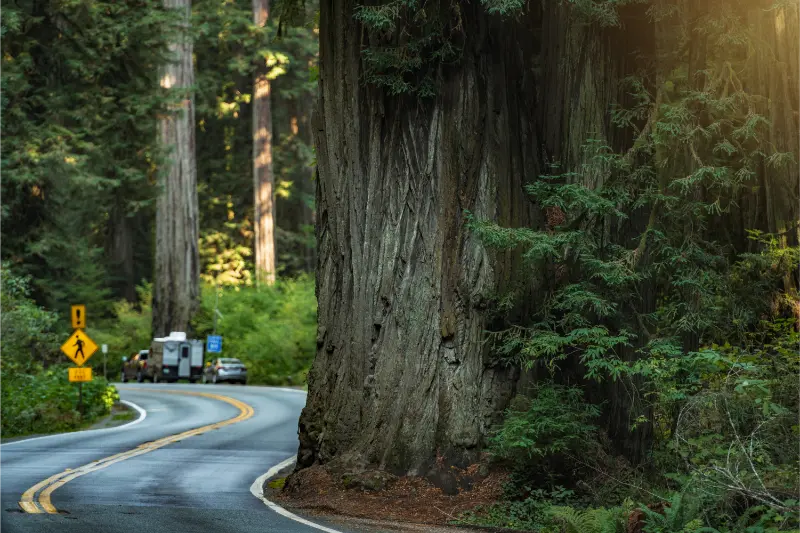
Avenue of the Giants farther south is another excellent option for travelers driving Highway 101. It is particularly useful for a scenic-road experience with repeated short grove stops. See the Avenue of the Giants road-trip guide.
Best giant sequoia trip for first-time visitors
Sequoia & Kings Canyon National Parks give travelers the classic giant sequoia experience around Giant Forest, General Sherman and Grant Grove. The parks are administered together but contain distinct areas, so plan by zone rather than assuming everything is next to one entrance.
Our Sequoia & Kings Canyon first-time guide explains how to divide the visit. Yosemite’s Mariposa Grove can also provide giant sequoias if Yosemite is already on the route and you do not have time for another national park.
Which is more impressive?
This is subjective because the experiences emphasize different forms of scale. Coast redwoods can feel impossibly tall. Giant sequoias feel extraordinarily thick and heavy, with huge bases and a sculptural presence. Travelers who expect one to look like a larger version of the other may miss what makes each ecosystem special.
If photography is your priority, redwood forests offer moody layers, ferns and shafts of light, while giant sequoia groves often create strong trunk textures and a warmer red-orange palette.
Which trip is easier from San Francisco?
If you only have one day from San Francisco, Muir Woods is the easiest famous coast-redwood option, though parking or shuttle reservations are required. For a true multi-day North Coast redwood trip, drive north through Sonoma/Mendocino or use Highway 101 toward Humboldt County.

Giant sequoias require a much longer Sierra journey. They make more sense when the overall route already includes Yosemite, Fresno or Sequoia & Kings Canyon.
Which is better with children?
Both can be excellent. Redwoods work well for children because several parks offer short forest walks and scenic drives. Giant sequoias can create an immediate “wow” moment around named trees and large groves. The better choice is the one that minimizes a long transfer after several other travel days.
Families should check trail surfaces, elevation and seasonal road access. A short grove walk that everyone enjoys is better than a famous trail that ends in complaints.
Which is better for older travelers or limited mobility?
Both regions include accessible or relatively easy experiences, but access varies by exact park. California State Parks publishes park-by-park accessible-feature information, and National Park Service sites publish their own accessibility guidance.
Choose a specific grove first, then research its parking, restroom and trail surface. “Visit the redwoods” is not detailed enough for accessibility planning.
Weather differences
Coast redwood country is often cool, damp and foggy compared with inland California. Summer mornings can require layers. Giant sequoia groves sit at mountain elevations where snow can affect access in winter and shoulder seasons.
This means the two experiences can fit different times of year. Redwoods are not automatically warm in summer, and the Sierra is not automatically snow-free because California beaches are sunny.
Driving and road style
Redwood trips often involve Highway 101, coastal roads and forest parkways. Driving can be long because Northern California is large, but the elevation changes are generally different from Sierra mountain routes.
Sequoia & Kings Canyon roads can be steep and winding. Drive in daylight if mountain roads make you uncomfortable and do not underestimate the time required between park zones. Weather and construction can also change access.
How many days?
For Redwood National and State Parks, plan at least two full days if you are making the long journey north. Three days allows different ecosystems and slower hiking. Avenue of the Giants can be a one-day road-trip section when combined with another North Coast base.
For Sequoia & Kings Canyon, two full days is a useful minimum for a first visit focused on the major groves and scenic stops. Three days works better if you want longer hikes or multiple park zones.
Can you see both in one California trip?
Yes, but only when the trip is long enough. A two- or three-week Northern California plus Sierra itinerary can include both. In a 10-day first trip, adding both usually creates too much driving unless trees are the central theme.
Our California national parks road trip shows why choosing parks geographically is more important than counting them.
Redwoods vs sequoias for a road trip
Choose coast redwoods if your route already includes San Francisco, Sonoma, Mendocino or the Oregon border. Choose giant sequoias if you are connecting Yosemite, Fresno, Kings Canyon or the southern Sierra. This single decision can save hundreds of miles.
Final recommendation
If you want the deepest forest atmosphere and the tallest trees, choose the coast redwoods. If you want the world’s most massive trees combined with Sierra mountain scenery, choose giant sequoias.
Neither is the “better” tree. The better trip is the one that fits the rest of California. Choose by route, season and travel style, then give the forest enough time to feel like a destination rather than a photo stop.
Muir Woods vs the far North Coast
Muir Woods is the practical coast-redwood choice when San Francisco is the center of a short trip. It provides an impressive old-growth forest without the multi-day drive to Humboldt and Del Norte counties, but parking or shuttle reservations are required and the experience is more concentrated. A North Coast trip offers a much larger redwood landscape with scenic highways, multiple parks, rivers and beaches.
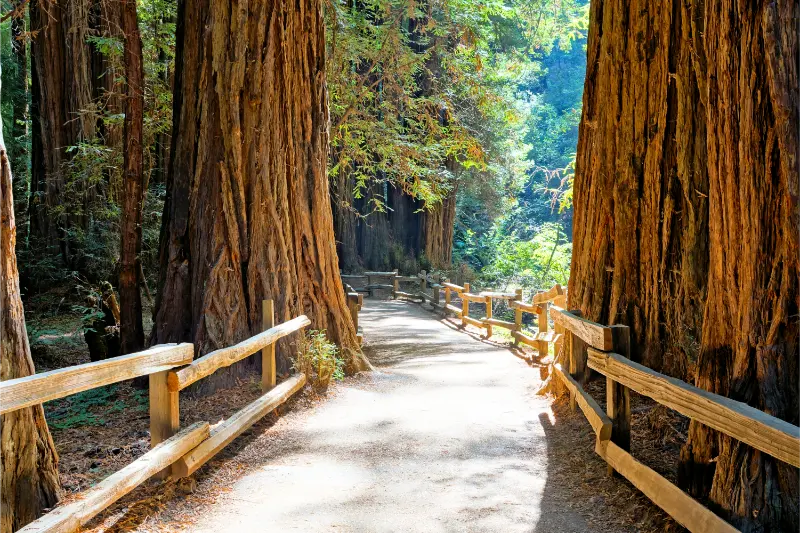
If redwoods are one item on a San Francisco itinerary, Muir Woods may be enough. If the forest is one of the main reasons you came to California, give Redwood National and State Parks several days.
Two sample routes that avoid unnecessary driving
Northern route: San Francisco → Sonoma/Mendocino → Avenue of the Giants → Eureka/Humboldt → Redwood National and State Parks. This makes coast redwoods part of a coherent North Coast journey.
Sierra route: San Francisco or Los Angeles → Yosemite → Sequoia & Kings Canyon → onward to Southern California or the Central Valley. This makes giant sequoias part of a mountain itinerary rather than a special detour across the state.
Which is better for photography?
Coast redwoods are excellent for atmospheric photography, especially in fog or soft forest light, but the enormous dynamic range between dark trunks and bright sky can be challenging. Giant sequoias often provide clearer individual-tree subjects and warm bark color, but wide-angle distortion can make trunks appear smaller than they feel in person.
In either forest, avoid blocking trails for photographs and respect barriers around roots and sensitive vegetation. The best image is not worth damaging the ecosystem that created it.